Kittens develop even faster than puppies: the entire journey from helpless newborn to young adult happens within about a year. Because the earliest changes arrive in weeks rather than months, this chart starts weekly and then moves to months. Every kitten is an individual, and the windows below are approximate.
The first year at a glance
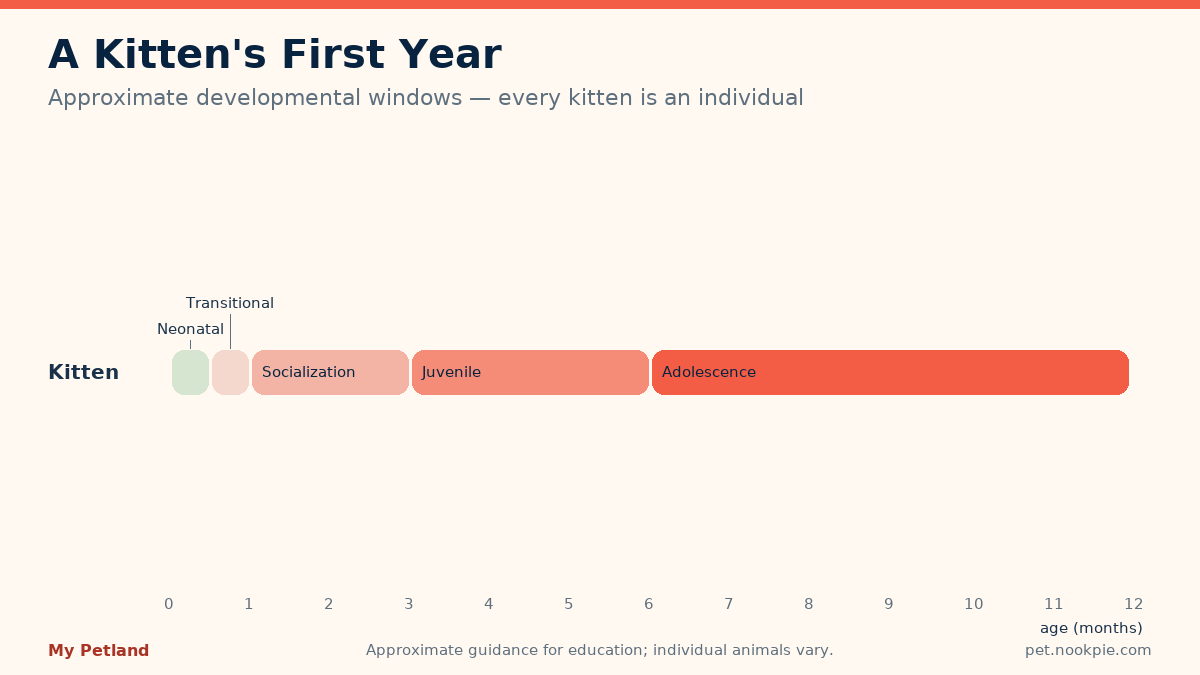
| Age | What is typically happening |
|---|---|
| 0–2 weeks | Eyes and ears closed; fully dependent on the mother; nursing and sleeping |
| 2–4 weeks | Eyes and ears open; first unsteady steps; baby teeth begin erupting; early play with littermates |
| 1–2 months | Weaning begins; litter-box habits emerge; the sensitive socialization period starts; most kittens go to new homes no earlier than eight weeks |
| 2–3 months | Peak socialization window; coordinated running, climbing, and play; first veterinary visits and vaccine series begin |
| 3–4 months | Rapid growth; adult teeth begin replacing baby teeth around month four |
| 4–6 months | Teething finishes; long-legged adolescent proportions appear; energy and mischief peak |
| 6–9 months | Sexual maturity approaches; growth rate slows; adult behavior patterns begin to settle |
| 9–12 months | Approaching the young-adult stage; most cats reach close to adult size by the first birthday |
The socialization window is early and brief
Feline behavior guidance places the most sensitive socialization period very early — roughly two to seven weeks of age. Positive, gentle exposure to people, handling, household sounds, and carriers during this window shapes how a cat responds to the world as an adult.
Because this window largely happens before a kitten comes home, what new owners can still do matters more than what was missed: continue gentle handling practice, keep the carrier out as furniture rather than a threat, and let the kitten set the pace of new encounters. Forcing interaction teaches fear, not confidence.
Kittens differ from puppies in the details
Cats do not vary much in adult size, so the feline calendar is more uniform than the canine one — there are no separate growth tracks for “small” and “giant” cats. Play style also differs: kittens practice stalking, chasing, and pouncing, and short supervised play sessions with appropriate toys support both development and household peace. Hands and feet should never be toys.
The cat age calculator shows where a kitten sits in the human-age comparison, and the cat life stages overview explains how kittenhood connects to the stages that follow.
What to watch at any week
Young kittens can decline quickly when something is wrong, and they cannot tell you. Track the daily baseline — eating, drinking, litter-box output, play, sleep, and behavior — so change stands out. The kitten daily care checklist provides the routine.
Contact a veterinarian promptly for a kitten that stops eating, has repeated vomiting or diarrhea, develops eye or respiratory discharge, or becomes unusually quiet or weak. Seek emergency care for breathing difficulty, collapse, suspected toxin exposure (including lilies), repeated seizures, or repeated attempts to urinate with little output.