Cats mature quickly during their first two years. After that, the familiar human-age comparison rises by about four years for each cat year. The chart is a simple analogy; the life stage and the cat’s own changes are better guides to care.
The approximate cat age chart
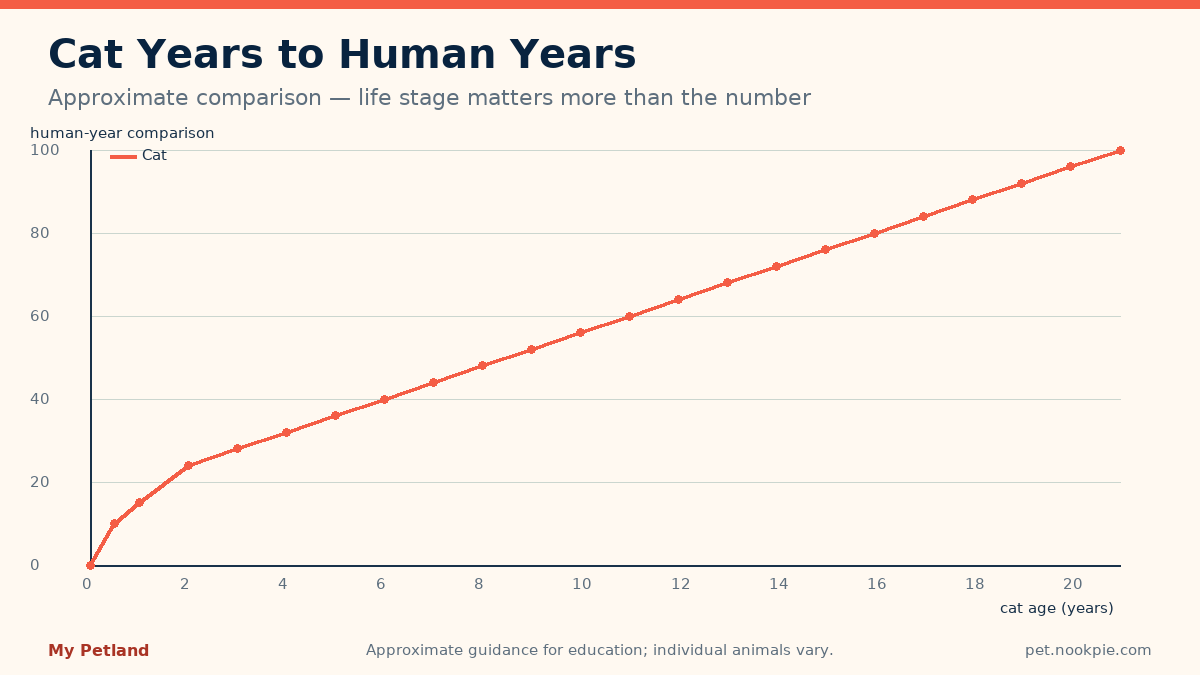
| Cat age | Human-age comparison | Life stage |
|---|---|---|
| 6 months | 10 | Kitten |
| 1 | 15 | Young Adult |
| 2 | 24 | Young Adult |
| 3 | 28 | Young Adult |
| 4 | 32 | Young Adult |
| 5 | 36 | Young Adult |
| 6 | 40 | Young Adult |
| 7 | 44 | Mature Adult |
| 8 | 48 | Mature Adult |
| 9 | 52 | Mature Adult |
| 10 | 56 | Mature Adult |
| 11 | 60 | Senior |
| 12 | 64 | Senior |
| 13 | 68 | Senior |
| 14 | 72 | Senior |
| 15 | 76 | Senior |
| 16 | 80 | Senior |
| 17 | 84 | Senior |
| 18 | 88 | Senior |
| 19 | 92 | Senior |
| 20 | 96 | Senior |
| 21 | 100 | Senior |
The calculator can accept months and interpolate between anchors. It marks ages above 21 as lower confidence because the four-year pattern is then being extended beyond the main source chart.
Why kitten development moves so fast
Six months maps to about 10 and one year to about 15 because kittens pass through major physical and behavioral development in a short calendar period. A straight multiplier would miss that early acceleration. The interval from one to two years adds another nine in the comparison, reaching about 24.
This does not mean a kitten has the judgment, social experience, or needs of a human child at the displayed age. Cross-species comparisons are illustrative, not literal.
Why the pattern becomes simpler after age two
The source chart uses a practical pattern of roughly four additional human years for each cat year after two. That makes the table easy to follow, but it is not a biological clock. Genetics, body condition, nutrition, health history, environment, and care all influence an individual cat.
Indoor or outdoor lifestyle may change exposure and preventive-care conversations, but it does not change the conversion formula. The calculator deliberately avoids pretending that it can calculate those complex effects.
Human-age analogy versus life stage
AAHA and AAFP define Kitten as birth to under one year, Young Adult as one through six, Mature Adult as seven through ten, and Senior as over ten. Those boundaries focus attention on evolving physical, behavioral, and medical needs.
The stages are still starting points. A senior cat can remain active and comfortable, while a younger cat can develop a change that needs prompt attention. Age should not be used to dismiss weight loss, hiding, house-soiling, altered grooming, reduced jumping, mouth discomfort, or a shift in appetite or water intake.
What to observe at any age
Use the same small set of observations consistently:
- weight and muscle condition;
- appetite and water intake;
- urine, stool, and litter-box comfort;
- vomiting or coughing;
- grooming and coat condition;
- play, jumping, walking, sleep, hiding, and social behavior;
- mouth odor, drooling, or changes in chewing.
A note about when a change began, how often it happens, and whether it is progressing can be more useful to a veterinarian than an age analogy. If a cat has breathing difficulty, collapses, is unresponsive, cannot urinate, may have encountered a toxin, has repeated seizures, or shows another severe or rapidly worsening sign, contact a local emergency veterinary service.
A practical way to revisit the chart
Use the table at birthdays or when learning about a newly adopted cat whose age is estimated. If the exact birth date is unknown, a veterinarian may give a broad chronological estimate from history and examination; the human-age output should remain equally broad.
Do not adjust the input to make a cat’s energy level “fit” a younger or older row. A playful senior is still a senior, and a quiet young adult may need attention. The chart describes time, while observation describes the individual.
When several people care for the cat, a shared weekly note can make gradual trends easier to recognize. Keep it simple: appetite, water, litter box, weight when available, movement, grooming, and behavior. The purpose is not constant surveillance; it is a clearer baseline when something changes.