Most dogs live somewhere between ten and thirteen years, but the honest answer depends heavily on size. Small dogs commonly reach their mid-teens, while giant breeds may be elderly before their eighth birthday. These are population patterns, not predictions: no chart can say how long one individual dog will live, and a dog well past the average can still be thriving.
Typical lifespan ranges by adult size
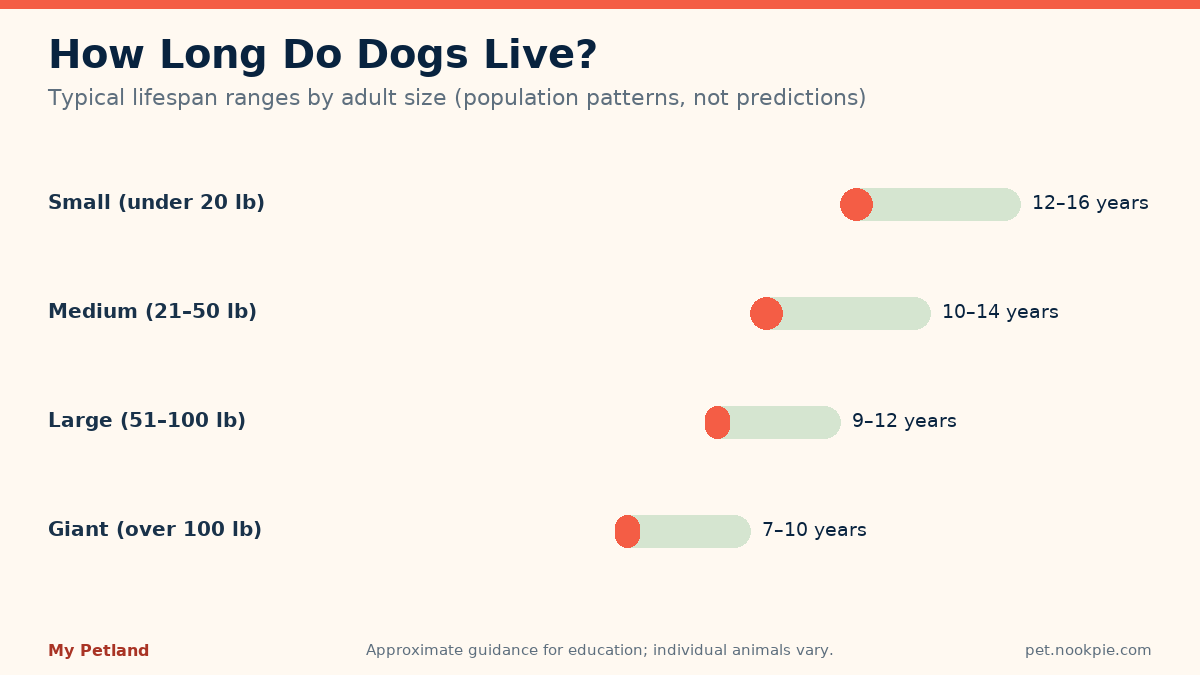
The ranges below are approximate patterns drawn from veterinary life-stage guidance and population research. They describe groups of dogs, not promises about yours.
| Adult size | Typical weight | Approximate lifespan range |
|---|---|---|
| Small | under 20 lb | about 12–16 years |
| Medium | 21–50 lb | about 10–14 years |
| Large | 51–100 lb | about 9–12 years |
| Giant | over 100 lb | about 7–10 years |
The spread within each band is wide. Genetics, body condition, medical history, environment, and care all move an individual dog within — and sometimes beyond — its band. Use the ranges as orientation, not as a countdown.
Why larger dogs tend to live shorter lives
The size pattern is one of the best-documented findings in canine aging research. A 2013 study of tens of thousands of dogs found that larger breeds reach age-related mortality earlier, and that the difference grows more pronounced with age — a trade-off unusual among mammals of the same species.
Researchers have proposed several explanations, including the rapid early growth of large puppies and differences in growth-hormone biology. The exact mechanisms are still being studied, so any confident single-cause explanation should be treated with caution. What is well supported is the pattern itself: size is one of the strongest predictors of how fast a dog moves through its life stages.
What else shapes a dog’s years
Size is not destiny. Research and clinical guidance point to several population-level influences:
- Body condition. Dogs kept at a lean, healthy weight tend to live longer than dogs carrying excess weight. A veterinarian can assess body condition at routine visits.
- Genetics and breed background. Some breeds carry higher risks for particular conditions. This affects groups, and says little about one dog.
- Preventive care. Regular veterinary visits, dental attention, and parasite planning catch changes earlier.
- Environment and daily life. Safety, activity suited to the dog’s stage, and prompt attention to new signs all matter.
None of these come with a guaranteed effect size for an individual, and this guide deliberately avoids assigning extra years to any single habit. Claims that one food, supplement, or routine will extend a specific dog’s life go beyond what current evidence can support.
Lifespan versus healthy years
Averages describe the length of life, not its quality. Two dogs with the same lifespan can spend very different portions of it comfortable, mobile, and engaged. Veterinary guidance increasingly emphasizes the senior stage as a period to manage actively — with more frequent checkups and closer observation — rather than an inevitable decline.
A dog is generally considered senior during roughly the last quarter of its expected lifespan. For a giant breed that may arrive around six or seven years; for a small dog, closer to ten or beyond. Our dog life stages overview maps these transitions in detail, and the senior dog care checklist covers day-to-day observation once a dog reaches that stage.
What averages mean for one dog
Population numbers cannot tell you where your own dog sits on its curve. The most useful response to a lifespan table is not worry but a baseline: know your dog’s normal weight, appetite, water intake, movement, sleep, and behavior, so that change is easy to spot at any age.
If you notice a new or progressing sign — reduced appetite, weight change, stiffness, altered breathing, or a shift in behavior — describe it to a veterinarian rather than waiting for it to match an expectation. Our guide on signs your pet needs a vet explains which changes warrant routine, prompt, or emergency attention.
Curious where your dog falls right now? The calculator shows both the human-age comparison and the current life stage.