A dog’s age in human years is best treated as an approximate comparison, not a conversion with one permanent multiplier. The first two annual anchors are similar across sizes. Later, small, medium, large, and giant dogs separate more clearly.
A compact size comparison
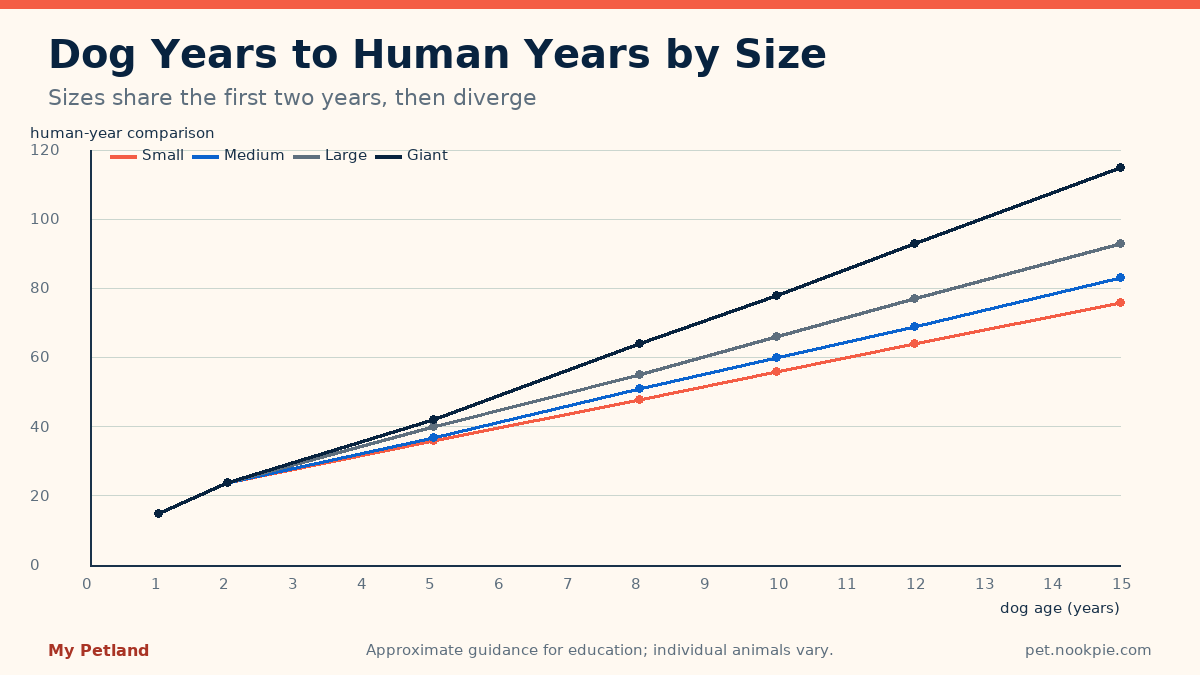
| Dog age | Small | Medium | Large | Giant |
|---|---|---|---|---|
| 1 | 15 | 15 | 15 | 15 |
| 2 | 24 | 24 | 24 | 24 |
| 5 | 36 | 37 | 40 | 42 |
| 8 | 48 | 51 | 55 | 64 |
| 10 | 56 | 60 | 66 | 78 |
| 12 | 64 | 69 | 77 | 93 |
| 15 | 76 | 83 | 93 | 115 |
These values come from the size-grouped AAHA/Zoetis physiological age chart. They make two patterns easy to see: dogs mature rapidly at the beginning, and adult size matters more as the years pass.
Why the first two years look similar
A one-year-old dog has already moved through much of puppy development. That is why age one maps to about 15 rather than seven. By age two, the chart places every size near 24. This does not mean all breeds develop identically; it is a broad anchor for an understandable comparison.
Months between known ages are interpolated for a smoother display. That is a user-interface choice, not a claim that bodies age in a perfectly straight line.
Why size matters later
AAHA’s clinical life-stage framework emphasizes that age, size, breed, lifestyle, and health affect preventive care. The age chart reflects one part of that variation by separating adult-size groups after age two.
At age eight, for example, the compact table gives about 48 for a small dog and about 64 for a giant dog. The difference is useful as context, but it cannot predict an individual dog’s health or remaining lifespan. A robust giant dog and a small dog with chronic health concerns still need individual assessment.
Which adult size should you choose?
Use expected healthy adult size, not a puppy’s current weight or a senior dog’s current weight after body-condition change.
- Small: 20 lb or less / 9 kg or less
- Medium: 21–50 lb / over 9–23 kg
- Large: 51–90 lb / over 23–41 kg
- Giant: over 90 lb / over 41 kg
For a mixed-breed dog near a boundary, choose the closest practical estimate. If you compare both neighboring groups, think of them as a broad range rather than trying to select the more flattering number. The life-stage and observation guidance are more important than a one- or two-year difference in the displayed analogy.
How size affects life-stage timing
AAHA defines senior status as the last portion of estimated lifespan rather than one birthday for every dog. My Petland therefore uses transparent size estimates in its calculator: around 11 years for small dogs, 10 for medium, 8 for large, and 7 for giant dogs. These are product boundaries, not breed-specific medical rules.
Growth timing also varies. The calculator keeps small and medium dogs in Puppy until around one year, large dogs until around 1.5 years, and giant dogs until around two. A veterinary team may place an individual differently after considering breed and development.
What the number cannot tell you
The comparison cannot determine biological age, diagnose a condition, set an exercise plan, select food, or predict lifespan. More useful trends include body and muscle condition, appetite, thirst, elimination, mouth comfort, activity, recovery, sleep, behavior, and changes from the dog’s own baseline.
When you notice a persistent or worsening change, record when it started and contact a veterinarian rather than trying to explain it from age alone. For severe signs such as breathing difficulty, collapse, serious bleeding, suspected toxin exposure, repeated seizures, or inability to urinate, contact a local emergency veterinary service.
How to use the result without over-reading it
Treat the output as a conversation opener. If a five-year-old large dog displays about 40 human years, the useful conclusion is not that the dog should behave like a forty-year-old person. Instead, note that the dog is no longer in early development and compare current condition with earlier adult patterns.
Recalculate when the chronological age changes, not whenever weight fluctuates. Adult-size group describes the dog’s expected healthy adult frame; it should not be changed to explain weight gain or loss. If a veterinarian believes another size or life-stage interpretation better fits the dog, use that individualized judgment.
For families with two dogs, resist using the comparison as a competition. A lower displayed age does not guarantee better health, and a higher number does not make decline inevitable. Each dog’s baseline, environment, and veterinary findings remain separate.