Aging dogs and cats sometimes change in ways that are hard to name: the dog who has slept through the night for a decade starts pacing at 3 a.m.; the cat who never missed the litter box starts going beside it; a pet who knew every family member seems to look through them. Owners often file these under “just getting old.” Veterinary medicine files them under findings — because cognitive dysfunction syndrome is a real, recognized condition in senior dogs and cats, and because many other conditions produce the very same picture.
This guide describes what owners typically notice first, why none of it should be self-labeled, and how to make your observations genuinely useful to your veterinarian.
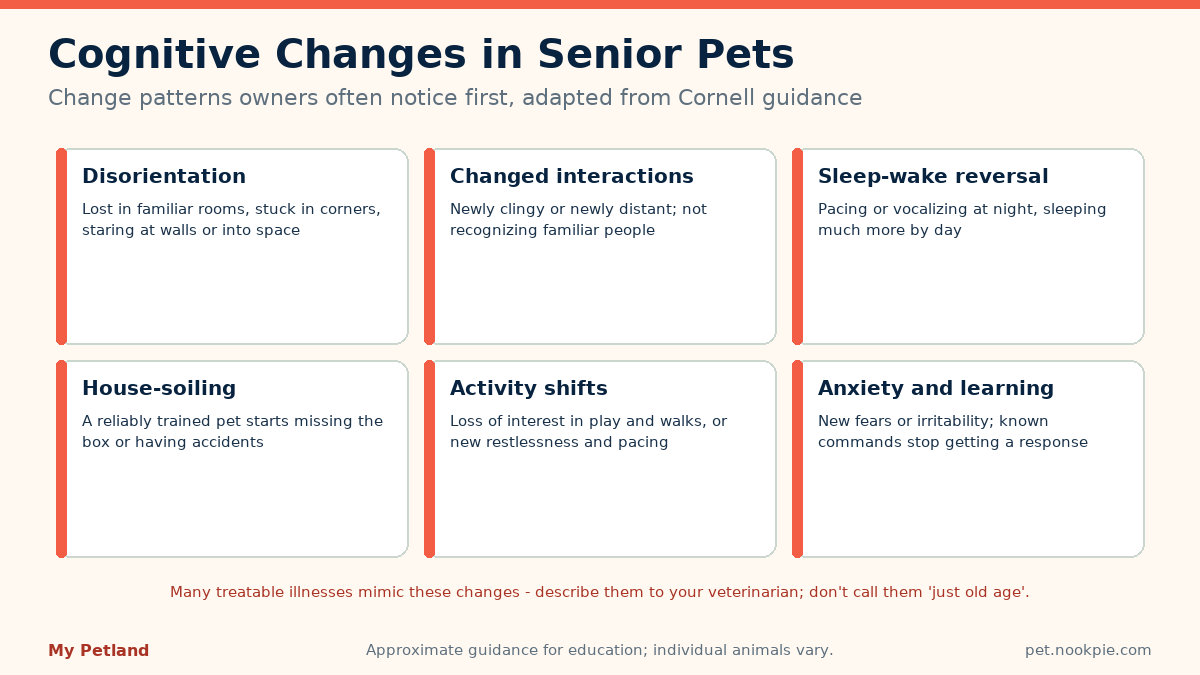
The change patterns owners notice first
Cornell’s veterinary hospitals describe a recognizable cluster of behavior changes in senior pets:
- Disorientation — getting lost in familiar rooms, becoming stuck in corners or behind furniture, staring at walls or into space.
- Changed interactions — a pet who was independent becomes clingy, or a sociable pet withdraws; some stop recognizing familiar people.
- Sleep-wake reversal — awake, pacing, or vocalizing at night (nighttime yowling is a classic senior-cat complaint), sleeping far more by day.
- House-soiling — a reliably housetrained dog has accidents; a fastidious cat eliminates outside the box.
- Activity shifts — lost interest in play, walks, and greeting rituals, or the opposite: new restlessness and repetitive pacing.
- Anxiety and learning changes — new fears, irritability, and familiar commands that stop getting a response.
In cats, Cornell notes these signs tend to become clearly noticeable from around age ten. One sign alone may mean little; the pattern and the trajectory matter more than any single odd evening.
Why “just old age” is the wrong label
Here is the crucial part: the same behaviors have many possible causes, and several are treatable. Cornell’s feline guidance lists the everyday mimics explicitly — arthritis pain that makes the litter box or the stairs not worth the trip, kidney disease that changes drinking and urination, thyroid disease and high blood pressure behind nighttime vocalizing and anxiety, dental pain behind lost interest in food, fading vision or hearing behind apparent confusion. A pet can also have cognitive dysfunction and one of these at the same time.
This is why cognitive dysfunction is diagnosed by exclusion: a veterinarian works through the physical causes first, with an exam and typically blood and urine tests, before the cognitive label is earned. No checklist on the internet — including this one — can do that job.
What you can do that actually helps
Observe and record. When did each change start? How often? Getting better, worse, or stable? A two-week log of sleep, toileting, appetite, and odd episodes turns a vague “he’s been weird lately” into something a veterinarian can act on. The senior dog and senior cat checklists are built for exactly this.
Report, don’t interpret. Describe behaviors, not conclusions. “She paces the hallway most nights from 2 a.m.” is useful; “she has dementia” is a diagnosis, and making it at home risks missing the kidney disease that actually explains it.
Keep the world navigable. Predictable routine, night lights on the route to water and litter, low-entry boxes, and non-slip paths reduce the daily friction for any senior pet — whatever the cause of the change. Our guide to senior pet home modifications covers these adjustments.
Stay gentle and engaged. Calm play, short training refreshers, and unhurried interaction keep a senior mind active. What helps medically — including any diet, supplement, or medication question — belongs entirely to your veterinarian; do not start anything on your own.
When to act sooner rather than later
Most cognitive changes build gradually and fit a routine appointment. Some do not. Sudden disorientation over hours or days, a head tilt, circling, collapse, seizures, or a pet who stops eating or drinking is not a “watch and log” situation — contact a veterinarian promptly. Our guide on signs your pet needs a vet separates routine, prompt, and emergency responses.
And the quietest warning: a change you find yourself explaining away. “He’s just old” is the sentence that most often precedes a treatable problem found late.
Common questions
Is confusion just a normal part of aging in pets? Common is not the same as normal or untouchable. Disorientation, altered sleep, and house-soiling in a senior pet are findings to report, not a stage to accept — many conditions that look like mental decline, including pain, kidney, and thyroid problems, are manageable when found.
My senior dog stares at walls and gets stuck in corners. Is it dementia? That pattern matches what Cornell describes for canine cognitive dysfunction syndrome, but only a veterinarian can weigh it — the same signs can come from sensory loss, pain, or other illness. Describe exactly what you see, when it happens, and how it has changed, and let the exam and tests sort the causes.
Can cognitive decline be prevented? There is no proven way to prevent it. Keeping a senior pet mentally engaged with gentle play and routine, and keeping its other health conditions well managed, are the supportive measures veterinary sources consistently describe — but honesty requires saying the evidence is still developing.